
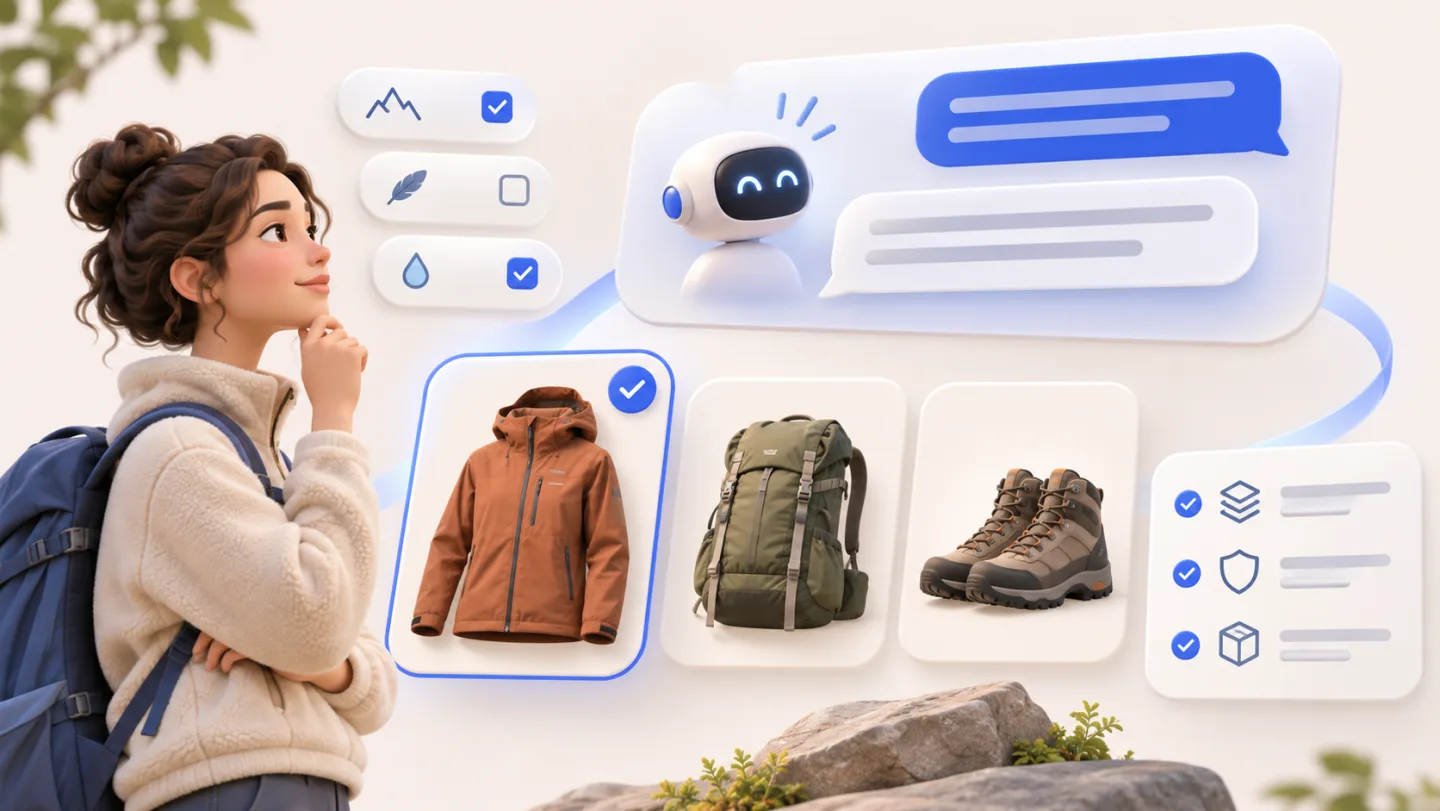
A shopper may know the problem they need to solve without knowing a product name. They might need a waterproof jacket within a budget, a compatible replacement part, or a gift for someone with specific preferences. A search box can return results, but a useful conversation can help clarify the constraints behind the search.
The challenge is not simply adding a chat interface. Recommendations need to reflect the right store view, current product facts, and the shopper's stated requirements. They also need to acknowledge when the catalog does not contain a suitable match.
Start with the decision, not the product list
Before recommending anything, identify the information that would change the choice. For a jacket, that might be intended activity, size, weather protection and budget. For a replacement part, compatibility can matter more than color or popularity.
Ask only the questions needed to narrow the choice. If the shopper already gave a budget or intended use, keep that context instead of asking again. If a crucial compatibility detail is missing, ask for it rather than implying that an item will fit.
A useful first release can focus on a small set of product categories where the catalog has reliable attributes and the support team knows which questions shoppers commonly ask.
Make catalog quality part of the rollout
An assistant can only compare products using information it can access. Review category assignments, filterable attributes, titles and descriptions. Make sure variations and store views are represented in the way customers actually shop.
For each pilot category, select real shopper questions and check whether the underlying product records contain enough information to answer them. A request for a waterproof jacket cannot be evaluated confidently if the catalog does not distinguish waterproof from water-resistant products. Missing facts should lead to an honest qualification or a follow-up question, not an invented specification.
Use current facts and show the limits
Product guidance should use the appropriate store context and verify price and availability from the connected catalog before presenting them as current. Customer-specific information requires a verified customer context and appropriate access controls.
Show a small number of relevant products with a clear reason for each suggestion. Link to the product page so the shopper can check details. If no available product meets every stated requirement, say so and explain which constraint could be relaxed. Do not substitute a different price, claim compatibility without evidence, or present an unavailable item as in stock.
Catalog data can change during a conversation. Define how long cached information remains valid and how a fresh lookup is triggered when the customer asks for an update.
Test conversations, not just single queries
Use a small test set drawn from real support themes, with personal information removed. Include follow-up messages such as “show a cheaper one,” a change in product category, a missing attribute, an out-of-stock item and a request that has no suitable match.
Compare the answer and product cards against independently checked Magento records. Review whether the recommendations meet all stated constraints, whether the displayed price and stock are accurate, and whether the assistant admits uncertainty. Include multiple store views and languages if the pilot will serve them.
Also test escalation. A customer who needs expert compatibility advice or has a complaint should be able to reach the appropriate support channel with enough context to avoid starting over.
Measure whether guidance helps
Agree on a baseline before the pilot. Depending on the store, useful measures may include product-card engagement, progression to product pages, assisted conversion, support handoffs and the rate of incorrect or unsupported recommendations. Segment by category and traffic source where practical.
These measures are indicators, not proof that the assistant caused a sale. Compare similar periods or use a controlled experiment where feasible, and review customer experience alongside conversion. There is no universal conversion uplift to expect.
Does conversational product discovery replace Magento search?
Not necessarily. Search is useful when shoppers know what they want; conversation can help when they need to explain a use case or compare options. The two can coexist.
What if catalog information is incomplete?
Identify the missing attribute, avoid making the unsupported claim, and ask the shopper or route the question to a person where appropriate. Improve the underlying product data for recurring gaps.
Can the assistant use private customer or order details?
Only when the integration has an authorized purpose and the customer context has been verified. Access to a product catalog alone should not grant access to private order information.
Where should a team start?
Choose one category, prepare its catalog data and support answers, then test a representative set of conversations against current store facts before broadening the rollout.